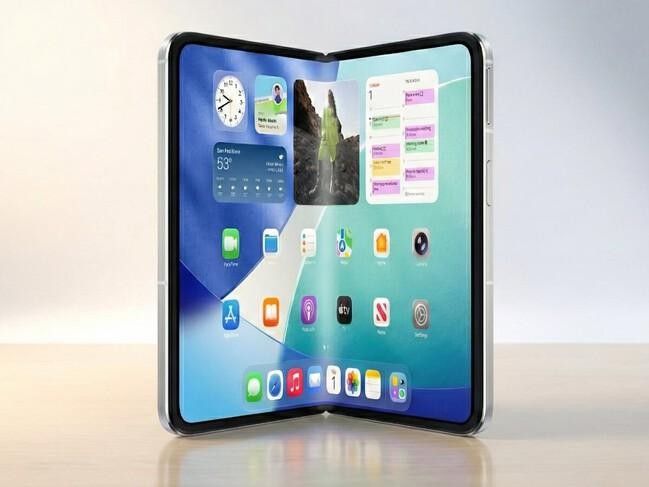
For years, the foldable smartphone market has been growing while Apple watched from the sidelines. Samsung, Motorola, Google and other manufacturers have already given consumers multiple generations of foldable phones, but Apple stayed committed to the traditional iPhone design. Now, that waiting game is over. Apple has officially entered the foldable phone race with the new iPhone Duo, and from the AMPS Magazine point of view, this is more than simply another iPhone—it is Apple’s attempt to redefine what a smartphone can be.
The iPhone Duo immediately separates itself with its size and design. When opened, the phone features a 7.6-inch Super Retina XDR folding display, which Apple says is 50 percent larger than the iPhone 18 Pro Max. When closed, users still have a 5.4-inch outer display that makes the device compact enough for everyday use. That combination gives consumers something many traditional smartphones cannot: a large screen for movies, gaming, multitasking and work without carrying a tablet. Apple has also added a nano-texture finish designed to reduce glare and make the folding display easier to view.

What makes the iPhone Duo competitive is that Apple is not relying on the folding screen alone. The company has combined the new form factor with its A20 Pro chip, Apple Intelligence, Siri AI, a 48MP Dual Fusion camera system, dual-battery technology and redesigned iOS 27 experiences. Users can place two apps side by side, prop the phone up for hands-free FaceTime, watch entertainment at different angles and use the larger display for productivity. The camera system also takes advantage of the folding design with features such as Smart Take and Duo Preview. Apple says the Duo can record 4K video at 120 frames per second and offers up to 31 hours of video playback on the inner display or 44 hours using the outer display.
The biggest question is simple: Why did it take Apple so long to get into the foldable race? Apple has not publicly provided one specific explanation, but the engineering challenges help explain the delay. Foldable phones require manufacturers to solve problems that traditional smartphones do not have, including hinge reliability, display durability, screen creasing, thickness and battery placement. Reports during development indicated that Apple was particularly focused on getting the hinge and display right. Apple ultimately built the Duo around a titanium frame and precision hinge, while using a multilayer display approach and nano-texture surface designed to improve durability and reduce the appearance of the crease.
That patience could be important. Apple is entering a market where Samsung has already spent years developing foldable technology. Counterpoint Research expects global foldable smartphone shipments to grow in 2026, with Apple potentially becoming a major player in its first year.
Of course, the iPhone Duo comes with an Apple-sized price tag. Starting at $1,999, it is clearly positioned as a premium device. Pre-orders begin October 16, with availability starting October 23. For AMPS Magazine, the iPhone Duo represents something bigger than a new phone. It shows how Apple often approaches technology: watch the market, study what works, identify what needs improvement and then enter when the company believes it can deliver the experience it wants. The question now is no longer whether Apple will join the foldable race. The question is what happens to the competition now that Apple is finally in the fold.