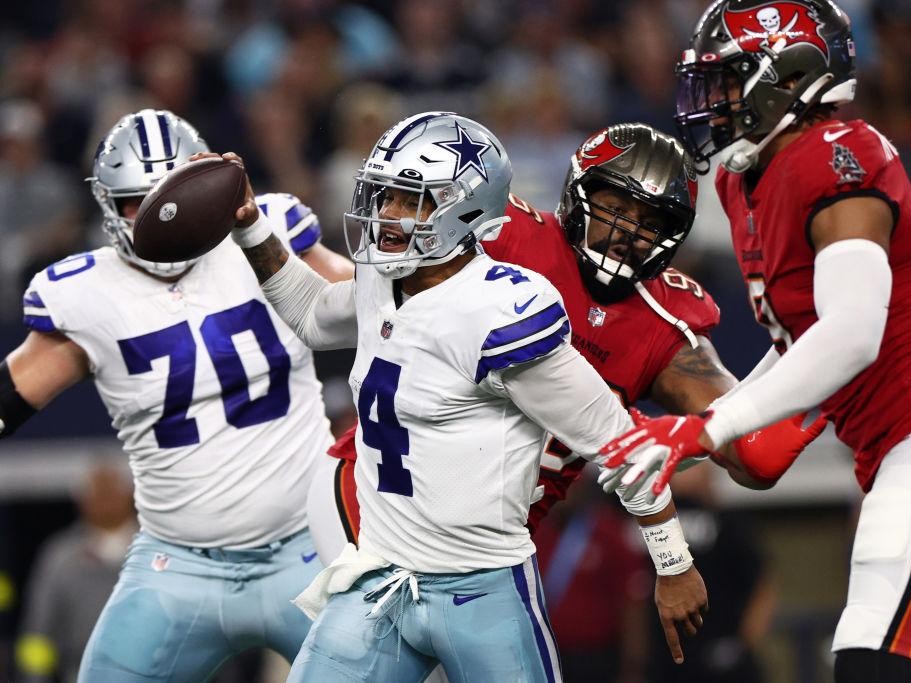
There are football games that leave fans disappointed, games that leave coaches searching for answers, and then there are games that leave an entire organization looking in the mirror. Thursday night’s 24–16 loss to the Tampa Bay Buccaneers was that kind of night for the Dallas Cowboys. At AT&T Stadium, against a team that entered the game without a victory, Dallas had an opportunity to get back on track. Instead, the Cowboys exposed familiar weaknesses, struggled to find their offensive rhythm, and watched Tampa Bay walk away with its first win of the 2026 season. The final score was eight points, but the difference between these two teams felt much larger.
At AMPS Magazine, we understand that one bad night does not define an entire season. However, when the same problems continue to surface, the conversation must change. Dallas cannot keep pointing to one missed assignment, one questionable coaching decision, one turnover, or one defensive breakdown. Thursday night was a reminder that winning in the NFL requires all three phases of the game to work together. Against Tampa Bay, the Cowboys never found that balance.
WHAT WENT WRONG? TOO MANY PROBLEMS, NOT ENOUGH ANSWERS
Let's begin with the defense, because once again, stopping the opposing offense proved to be a major problem. Tampa Bay entered the game with undrafted rookie quarterback Jalon Daniels making his second NFL start in place of the injured Baker Mayfield. This was an opportunity for Dallas to put pressure on an inexperienced quarterback and force him into uncomfortable situations. Instead, Daniels looked composed, made timely throws, used his mobility, and helped lead an offense that produced 419 total yards.
The bigger problem was running back Bucky Irving, who rushed for a career-high 165 yards and scored twice. His 72-yard run immediately after halftime changed the momentum and helped Tampa Bay take control. The Buccaneers finished with 241 rushing yards, exposing Dallas' tackling issues and inability to consistently close running lanes. When a defense cannot stop the run, the opposing quarterback has more freedom to manage the game, and that is exactly what happened Thursday night.
Dallas also struggled to generate enough pressure. The Cowboys needed to make Daniels uncomfortable, disrupt his timing, and force him to make difficult decisions. Instead, Tampa Bay found opportunities to move the chains and attack downfield. The absence of cornerback Joey Porter Jr., who was ruled out because of illness before kickoff, did not help matters. Still, one player's absence cannot explain an entire defensive unit's struggles. Better adjustments, more effective tackling, and greater consistency are necessary if Dallas expects to compete against stronger opponents.
Then there was the offense, which had its own share of problems. Dak Prescott completed 24 of 42 passes for 316 yards and one touchdown, but he also threw two interceptions. Both interceptions came on tipped passes, illustrating how quickly a promising possession can turn into a costly mistake. Dallas opened the game with a 70-yard scoring drive capped by Javonte Williams' one-yard touchdown run. That opening suggested the Cowboys might be ready for a productive night. Unfortunately, the offense struggled to sustain that momentum.
George Pickens was one of the few bright spots, recording nine receptions for 130 yards and a touchdown. His ability to make plays downfield gave Dallas a chance to rally late. However, CeeDee Lamb, coming off a spectacular performance against Houston, was held to minimal production before leaving with a quadriceps injury. Tampa Bay's defensive pressure and coverage disrupted the passing game, while Dallas' inability to establish a consistent running attack made the offense easier to defend.
The Cowboys finished with only 50 rushing yards as a team. That is not the kind of production that allows an offense to control the tempo, take pressure off its quarterback, and keep the opposing defense guessing.
SPECIAL TEAMS AND COACHING: THE LITTLE THINGS THAT BECOME BIG PROBLEMS
Special teams also played a role in Dallas' frustration. KaVontae Turpin's kickoff return ended in a fumble that Tampa Bay recovered, setting up a field goal that extended the Buccaneers' lead to 24–10. In a game where Dallas was already struggling to find answers, giving away another possession was a costly mistake.
Coaching decisions deserve examination, too. Dallas attempted a two-point conversion after Prescott connected with Pickens for a fourth-quarter touchdown. The attempt failed, leaving the Cowboys down by eight rather than seven. The decision reflected the coaching staff's preferred approach to game situations, but it also raised a reasonable question about whether the timing was right. Aggressiveness has its place in football, yet coaches must weigh the score, the clock, the team's momentum, and the probability of success.
Tampa Bay coach Todd Bowles also made an aggressive decision late in the game, choosing to go for it on fourth-and-goal from the Dallas one-yard line while holding a 24–10 lead. The Buccaneers failed to score, giving Dallas an opportunity to make the game interesting. The Cowboys capitalized on that opening with a long touchdown drive, but their two-point attempt failed, and Tampa Bay's defense ultimately shut the door. Even with its own questionable decisions and penalties, Tampa Bay made enough winning plays to escape with the victory.
WHAT WORKED FOR DALLAS?
Despite the disappointment, there were positives worth recognizing. Prescott threw for more than 300 yards, Pickens delivered a productive performance, and the opening scoring drive demonstrated that Dallas has the talent to move the football. The late touchdown drive also showed that the offense could respond when the pressure increased.
The problem is that flashes of potential are not enough. Dallas must turn those moments into four-quarter consistency. The defense needs to create pressure and limit explosive plays. The offense must protect the football, establish a stronger running game, and improve its response to defensive pressure. Special teams must eliminate mistakes that give opponents extra opportunities.
Those improvements are not optional if the Cowboys intend to make a serious postseason push.
WHY THIS GAME WAS DIFFERENT
What made Thursday night different from some of Dallas' earlier struggles was the opponent and the circumstances surrounding the matchup. Tampa Bay arrived winless, without its starting quarterback, and with every reason to be considered vulnerable. Dallas was playing at home under the national spotlight and had the opportunity to build confidence against a team still searching for its first victory.
Instead, the Buccaneers played with urgency, discipline when it mattered most, and a clear understanding of how to attack Dallas. Their running game established control, Daniels protected the football, and the defense created three turnovers. Tampa Bay also controlled possession for 39 minutes and 21 seconds, compared with just 20 minutes and 39 seconds for Dallas. Those numbers tell a story of a team that controlled the flow of the game rather than simply getting lucky at the right moment.
The Cowboys had their opportunities. Tampa Bay's penalties and failed fourth-down attempt gave Dallas openings, but the home team could not take full advantage. When a team repeatedly needs its opponent to make mistakes before it can gain momentum, that team has a problem of its own.
THE AMPS MAGAZINE TAKEAWAY
Here is the reality: the Cowboys do not need another round of excuses. They need accountability, better execution, and adjustments that produce results on the field. This loss cannot be placed entirely on Prescott, the defense, special teams, or the coaching staff. Each had a role in what happened, and each must examine what could have been done differently.
Prescott acknowledged after the game that the performance came close to embarrassing, while also recognizing Tampa Bay's accomplishment. That distinction matters. The Buccaneers earned this victory, and their record entering Thursday night should not diminish the effort they delivered.
For Dallas, however, the disappointment is understandable. Expectations are different when you wear the Cowboys uniform. Fans expect the team to compete, respond to adversity, and win games it is favored to win. The name on the jersey does not guarantee victory, and talent alone cannot overcome poor execution.
At AMPS Magazine, our message to Cowboys Nation is simple: do not confuse disappointment with defeat for the season. There is still time to correct mistakes, but time means little without action. Dallas must show that Thursday night was a wake-up call rather than another chapter in a familiar story.
The question is no longer whether the Cowboys have enough talent. The question is whether they can get everyone moving in the same direction, execute when the pressure rises, and play winning football for four quarters.
Because in the NFL, a team cannot live on its reputation. Eventually, it must prove itself on the field.